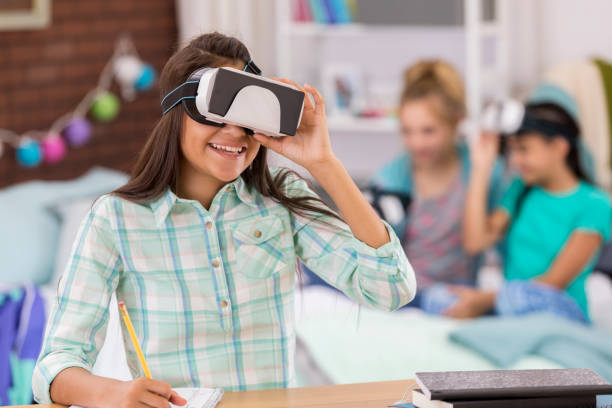
Education has always had a reputation for being serious, structured, and sometimes, let’s face it, a little boring. For generations, students have sat in classrooms, staring at chalkboards, flipping through textbooks, and occasionally nodding off during long lectures. But in recent years, technology has stepped in to make learning less about memorization and more about experience—and nothing exemplifies this shift better than Virtual Reality (VR). VR is turning traditional classrooms on their heads, making education not just more interactive, but genuinely fun.
Immersive Learning Experiences
Imagine learning about the solar system not from a textbook, but by actually “walking” through space. That’s the power of VR in education. Instead of trying to visualize abstract concepts like the orbit of planets or the structure of DNA, students can now experience them firsthand. They can zoom into the heart of a volcano, swim with virtual dolphins in the ocean, or even step into historical battles.
This kind of immersion does more than just entertain—it helps students retain information better. Studies have shown that interactive learning experiences significantly improve memory recall compared to passive reading or watching videos. With VR, lessons are no longer confined to 2D representations; they become multi-sensory adventures.
Breaking the Classroom Boundaries
One of the biggest limitations of traditional education is the physical space of a classroom. VR shatters that limitation. With VR headsets, a student in a small town in India can explore the Louvre in Paris, walk the streets of Ancient Rome, or dive into the Great Barrier Reef without leaving their home.
This borderless learning experience allows students to explore cultures, histories, and environments that would otherwise be impossible. For students in remote areas, VR can be a gateway to experiences they might never have, leveling the playing field and broadening their worldview.
Gamification: Learning That Feels Like Play
Part of what makes VR so effective is its natural ability to gamify learning. Many VR educational programs incorporate game mechanics—points, levels, challenges—to make studying feel less like a chore. For instance, students learning chemistry can “mix” chemicals safely in a virtual lab, earning points for correct reactions while avoiding virtual explosions for mistakes.
Gamification taps into our brain’s reward system, making students more motivated to learn. It’s the difference between slogging through a boring worksheet and actually feeling excited to tackle a challenge. VR turns education into an adventure, and when learning feels like play, engagement naturally skyrockets.
Catering to Different Learning Styles
Not all students learn the same way. Some are visual learners, others are auditory, and some thrive on hands-on experiences. VR can cater to all these learning styles simultaneously. Visual learners can benefit from 3D models and simulations, auditory learners can listen to explanations and narrations in immersive environments, and kinesthetic learners can physically interact with objects in VR.
This flexibility makes education more inclusive. Students who struggled in traditional classrooms might suddenly find themselves excelling when learning is presented in a way that resonates with them. In short, VR doesn’t just make learning fun—it makes it more accessible.
Making Difficult Subjects Easier
Subjects like physics, chemistry, and biology often intimidate students because of their abstract nature. VR can simplify these topics by turning them into tangible experiences. Instead of memorizing the stages of cell division, students can “enter” a cell and watch it divide in real-time. Instead of reading about Newton’s laws, they can conduct experiments in a virtual lab and observe the results firsthand.
This hands-on approach reduces anxiety around tough subjects, fosters curiosity, and encourages students to experiment without fear of real-world consequences. Learning becomes an exploration rather than a test.
Teachers as Guides, Not Lecturers
VR also changes the role of teachers. In a VR classroom, educators are no longer the sole source of information. Instead, they act as guides, facilitating experiences, answering questions, and helping students make sense of what they encounter. This shift encourages a more interactive and student-centered learning environment.
Teachers can monitor progress in real-time, identify which students are struggling, and adapt lessons accordingly. VR doesn’t replace teachers—it empowers them to teach more effectively and creatively.
The Social Aspect of VR Learning
While VR might seem like a solitary experience, it can actually enhance social learning. Many VR platforms allow multiple users to enter the same virtual environment simultaneously, collaborating on projects, solving problems together, or competing in educational games.
This adds a social dimension to learning that traditional online classes often lack. Students can discuss, debate, and collaborate in immersive spaces, improving teamwork skills and making learning a shared adventure rather than an isolated task.
Challenges and Considerations
Of course, VR in education isn’t without its challenges. High-quality VR equipment can be expensive, and not all schools have the budget to implement it. Some students may experience motion sickness, and content quality varies widely between platforms. Additionally, educators need proper training to integrate VR effectively into their lessons.
Despite these hurdles, the potential benefits outweigh the drawbacks. As technology becomes more affordable and accessible, VR is poised to become a staple in classrooms worldwide.
Looking Ahead
The future of education is undeniably interactive, and VR is leading the way. It has the potential to revive the excitement of learning, making it more engaging, inclusive, and memorable. As VR content grows more sophisticated, we can expect virtual classrooms to become as normal as physical ones, blending traditional teaching methods with immersive, playful experiences.
Education is no longer just about memorizing facts—it’s about experiencing, exploring, and enjoying the journey of learning. Thanks to VR, students everywhere can finally have fun while learning, and that’s a change worth celebrating.