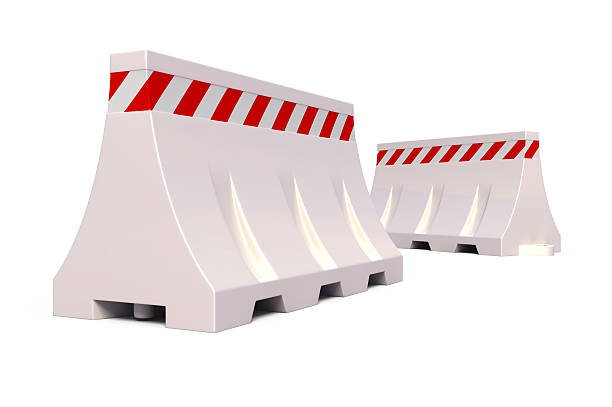
Roadwork, construction projects, temporary closures, public events, and controlled-access sites often require substantial physical separation between vehicles, workers, pedestrians, and restricted areas. Concrete barrier rental gives contractors, event teams, property managers, and public agencies access to heavy barrier systems for a defined period without requiring permanent storage or long-term ownership.
What Are Concrete Jersey Barriers?
Concrete Jersey barriers are heavy, modular structures commonly used to divide traffic lanes, protect work areas, control vehicle movement, and form temporary site boundaries. Their distinctive shape typically includes a broad base, sloping lower sides, and a narrower upper section.
The design helps create a visible and substantial boundary while allowing individual units to be positioned in connected lines. Depending on the application, barriers may be placed end to end or used as separate blocks around entrances, equipment, pedestrian areas, and temporary work zones.
Concrete barriers are considerably heavier than steel crowd-control barricades or plastic pedestrian barriers. Their weight makes them harder to move without suitable lifting equipment, which is one reason they are often selected for projects requiring a more substantial temporary boundary.
When Does Renting Make Sense?
Renting may be appropriate when barriers are required for a limited project, seasonal event, short-term closure, or temporary traffic plan. Purchasing concrete barriers can create additional responsibilities involving delivery, lifting, storage, inspection, and future transportation.
A contractor working on a three-month construction project may not need to own barriers after the project ends. Similarly, a venue hosting an occasional large event may require perimeter control for only a few days each year.
Rental also allows organisations to adjust the quantity based on each site. A small parking-area closure may require only several barriers, while a road project or large public gathering may call for a much longer continuous line.
The most suitable arrangement depends on the project duration, site conditions, transport requirements, and whether the organisation has suitable storage space after use.
Common Uses for Concrete Barriers
Concrete barriers are used across construction, transport, property management, municipal work, and event operations.
Common applications include:
- Separating traffic from active work zones
- Closing roads or vehicle access points
- Dividing parking areas
- Protecting temporary pedestrian routes
- Creating restricted equipment zones
- Controlling access around large public events
- Marking temporary site perimeters
- Supporting traffic-management layouts
Their use should always match the intended purpose. A standard concrete barrier placed as a visual boundary is not automatically certified to stop a vehicle travelling at speed.
Where impact resistance or crash-rated protection is required, the project team should confirm that the barrier system, installation method, and layout meet the relevant requirements for that specific application.
Concrete Barriers vs Lightweight Barricades
Concrete barriers and lightweight barricades are not interchangeable. Each serves a different role within site and crowd planning.
Steel crowd-control barricades are mainly used to guide pedestrians, form queue lanes, and separate public areas. Plastic barriers are easier to move and may be suitable for temporary pedestrian guidance, light-duty closures, and high-visibility marking.
Concrete barriers are much heavier and require mechanical handling. They are generally selected when the site needs a more substantial division or when accidental movement would be a concern.
Before choosing a barrier type, planners should consider:
- Whether the area involves vehicles or pedestrians
- The expected duration of use
- The ground surface
- Available installation equipment
- Emergency and delivery access
- Local safety requirements
- Whether rated vehicle protection is required
Using equipment that does not match the site risk can create a false sense of security.
Planning Delivery and Placement
Concrete barrier delivery requires careful preparation. A delivery vehicle must be able to enter the site, approach the planned placement area, and operate without blocking unsafe portions of the road or work zone.
The provider should be told about narrow entrances, overhead restrictions, soft ground, slopes, underground services, and limited turning space. These conditions may affect which vehicle or lifting method can be used.
A site plan should identify:
- The exact barrier line
- The number of units required
- Openings for authorised access
- Emergency routes
- Pedestrian crossings
- Drainage points
- Equipment and delivery lanes
The ground should be reasonably stable and suitable for the weight of the barriers. Placement on soft soil, unstable surfaces, or steep slopes may require additional assessment.
Organisers should avoid changing the layout after delivery unless the work is carried out by people with appropriate equipment and experience. Concrete barriers should never be pushed, rolled, or dragged casually into place.
Estimating the Required Quantity
Estimating quantity begins with the total length of the proposed barrier line. Divide that distance by the usable length of each rental unit, then allow for gaps, corners, entrances, and changes in direction.
The barrier provider should confirm the exact dimensions of the available units because sizes can differ. Connection points or spacing requirements may also affect the final calculation.
It is useful to separate the plan into individual sections, such as:
- Main roadside boundary
- Site entrance
- Pedestrian walkway
- Equipment storage area
- Parking restriction zone
- Event perimeter
This makes it easier to identify missing sections before the order is finalised.
Project teams should also decide whether additional barriers may be needed if the work area expands or the traffic plan changes.
Questions to Ask Before Renting
Before booking, confirm what the rental price includes. Delivery, placement, removal, collection, minimum rental periods, and distance charges may be priced separately.
Useful questions include:
- What are the barrier dimensions and weights?
- Is delivery included?
- Does the provider place each barrier?
- Is collection included at the end of the rental?
- What site access is required?
- Are there minimum quantities?
- What happens if the rental period is extended?
- How are damaged or missing units charged?
- Are barriers available for the required dates?
- Can the provider assist with estimating quantity?
The rental agreement should clearly state the responsibilities of both the provider and the customer.
Safety and Site Management
Concrete barriers should be included in the wider traffic, construction, or event management plan. Their placement should not obstruct emergency access, drainage, accessible routes, fire lanes, visibility at junctions, or approved pedestrian paths.
Where barriers are used near traffic, suitable signs, warning lights, reflective markings, or other visibility measures may be required. The exact requirements will depend on the location, project type, and local rules.
Barriers should be inspected during the rental period, especially after vehicle contact, severe weather, ground movement, or changes to the surrounding work area. Damaged, shifted, or unstable units should be reported promptly.
Concrete barriers can provide a substantial temporary boundary, but safe use depends on correct selection, professional handling, and careful site planning. Contractors, event organisers, property managers, and public agencies can visit Epic Crowd Control to review concrete Jersey barrier options, rental arrangements, delivery considerations, and other temporary traffic-control equipment.