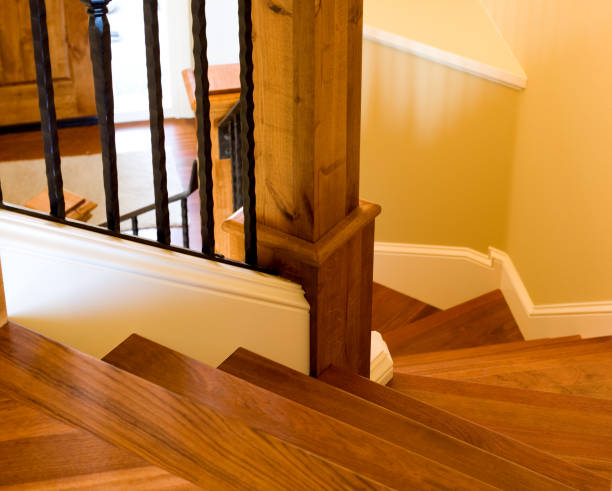
Selecting stair treads involves decisions about dimensions, wood species, construction, return configuration, and finish. One of the most important choices is whether to order the material prefinished or complete the finishing work at the property. The right option depends on the project schedule, installation environment, desired color, available labor, and relationship between the staircase and surrounding flooring.
What Are Prefinished Stair Treads?
Prefinished treads receive their stain and protective coating before they arrive at the project site. The installer receives components with most of the visible finishing work already completed.
This approach can be useful for residential remodeling, new home construction, and other projects where on-site sanding and coating would be difficult. The material must still be measured, cut, fitted, and installed correctly, but the finishing stages are handled before delivery.
Prefinished products may help reduce:
- On-site sanding
- Stain application
- Drying and curing periods
- Dust in occupied properties
- Finish odors
- Access restrictions during coating
- Coordination between installers and finish crews
Because the finish is already applied, measurements and specifications must be confirmed carefully before ordering.
When Prefinished Treads Make Sense
Prefinished material is often appropriate when the project team wants to limit work inside the building. This can be valuable in occupied homes, retail properties, and remodeling projects where residents or other trades need continued access.
These products may also support projects with tight schedules. Site finishing normally requires several separate stages, including surface preparation, staining, coating, drying, and inspection. Weather and indoor conditions can affect the time needed between stages.
Prefinished treads may be considered when:
- The property will remain occupied during construction
- Dust and odors must be limited
- A consistent finish is a high priority
- The schedule does not allow several finishing visits
- The staircase needs to reopen quickly
- Finishing labor is difficult to coordinate
- The selected factory finish meets the design requirements
The installer should protect finished surfaces during storage, cutting, fitting, and installation.
When Unfinished Treads May Be Preferred
Unfinished treads arrive without stain or a protective topcoat. They allow the finish contractor to complete the color and coating process at the property.
This option may be suitable when the staircase must be matched to flooring that will also be finished on site. It may also be useful when the designer requires a specialized stain, sheen, distressing method, or decorative treatment that is not available as a prefinished selection.
Unfinished material may be preferred when:
- The flooring and staircase will be stained together
- A custom color must be developed on site
- Field modifications are extensive
- The project requires a specialized finish
- The finish contractor needs control over the full process
- Existing woodwork must be matched at the property
- Jobsite conditions permit sanding and coating
The project schedule should include adequate time for preparation, staining, coating, and curing.
Compare Labor Beyond the Purchase Price
Material price should not be reviewed separately from labor and scheduling. An unfinished tread may have a lower initial product cost, but the project must also account for sanding, staining, coating, protection, and return visits.
A cost comparison should include:
- Material price
- Finishing labor
- Stain and coating materials
- Jobsite protection
- Equipment setup
- Drying and curing time
- Crew travel
- Temporary loss of staircase access
- Touch-up requirements
Prefinished material shifts much of the finishing work away from the property. Unfinished material provides greater control at the jobsite but requires more labor and coordination.
Consider Color-Matching Requirements
Color coordination is one of the main reasons to compare both options carefully. Hardwood species vary naturally, and the same stain can appear different depending on grain structure, board color, application method, and lighting.
When coordinating treads with flooring, review:
- Wood species
- Flooring manufacturer and finish
- Stain undertone
- Grain pattern
- Finish sheen
- Natural board variation
- Lighting near the staircase
- Nearby risers, handrails, and newel posts
Physical samples should be reviewed whenever possible. A digital photograph may not represent the actual color accurately, particularly under different lighting conditions.
If an exact match is not practical, a complementary or contrasting finish may produce a more intentional result than a close but visibly different match.
Plan for Cutting and Field Adjustments
Most stair installations require some on-site cutting and fitting. With prefinished material, contractors should plan cuts so factory-finished surfaces remain intact wherever they will be visible.
Finished pieces should be handled with clean gloves and placed on protected work surfaces. Saw tables, supports, and surrounding areas should be checked for debris that could scratch the coating.
Unfinished treads provide more freedom for sanding after fitting, but excessive field correction may still affect tread dimensions, nosing consistency, and the final appearance.
Before ordering either option, confirm:
- Individual tread widths
- Tread depth and thickness
- Left, right, double, or closed returns
- Landing dimensions
- Nosing requirements
- Skirt board conditions
- Upper-floor transitions
- Anticipated field cuts
Accurate measurements reduce the amount of modification needed during installation.
Coordinate the Complete Staircase
The tread finish should be selected alongside the other visible stair components. Risers, landing tread, moulding, handrails, balusters, and newel posts all contribute to the final appearance.
The material schedule should identify:
- Tread species and finish
- Riser material and color
- Landing treatment
- Handrail species and stain
- Wood or iron balusters
- Newel post finish
- Cove moulding and veneer
- Required touch-up materials
Ordering related components together can help the project team review finish compatibility before installation begins.
Use a Final Selection Checklist
Before choosing prefinished or unfinished material, ask:
- Will the property remain occupied?
- Is on-site finishing practical?
- Does the staircase need to match site-finished flooring?
- Is a suitable prefinished color available?
- Who will complete the finishing work?
- How much curing time does the schedule allow?
- Are extensive field modifications expected?
- How will finished pieces be protected?
- Have all visible stair components been coordinated?
Both options can produce a well-planned hardwood staircase when selected for the right project conditions. Flooring dealers, contractors, builders, architects, and designers can visit Wood Stair Co to compare prefinished and unfinished treads, risers, landing materials, moulding, handrails, and other staircase components.